The Project
This project forms the basis of the lead researcher’s PhD programme. The overall project is aiming to explore what it’s like for adults who have self-diagnosed as autistic and/or ADHD because of content that they’ve seen on social media. Self-diagnosis has become controversial and political, but the majority of the reports on this process involve waiting list times, numbers of referrals, and increasing incidence rates (i.e. how many new diagnoses of autism/ADHD there have been within a specific time period). There are lots of reasons for increasing rates of autism & ADHD, including changes to the criteria used to diagnose them, and increased awareness of how neurodivergence presents in historically marginalised groups. Therefore, while the numbers might tell one story, it isn’t the whole story. This project aims to explore self-diagnosis of neurodivergence by asking people about the motivations behind it, how social media helped shape their thinking around their own potential neurodivergence, and how self-diagnosing has impacted their lives. This will provide a more balanced, in-depth picture of autism/ADHD self-diagnosis.
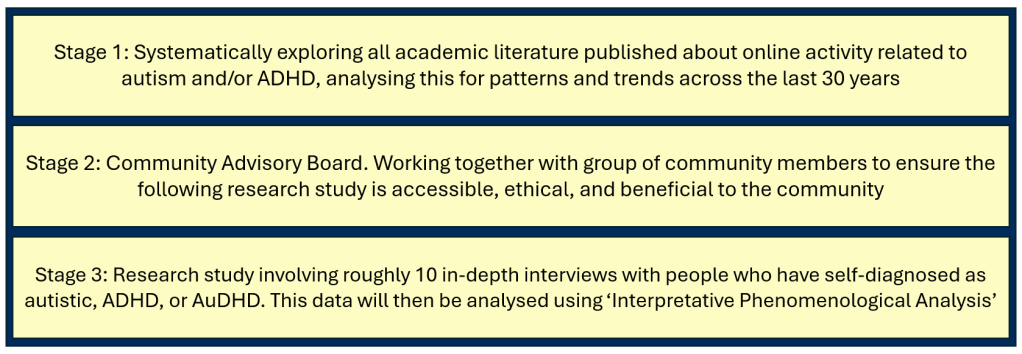
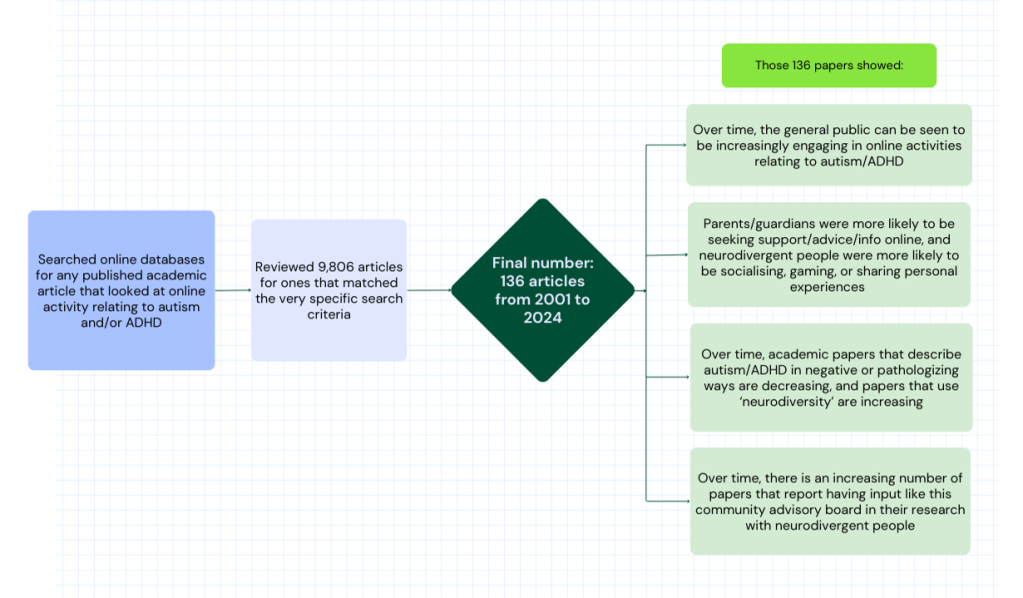
Stage 1: Systematic literature review
Stage 2: Community Advisory Board
This part of the project is where I’ll be working with what’s known as a ‘community advisory board’. This is a type of research that is known as ‘participatory’. In simple terms, this means getting involvement from the community that the research is about. For example, if the research is trying to find out how to make asthma more manageable, the research team might ask people with asthma. This sounds obvious, but it doesn’t happen all the time. In this project, because my focus is autistic and/or ADHD people, I will be working with them directly to explore the project’s aims. In Phase 1, this will take the form of asking a group of neurodivergent people to join the research team to help make decisions and improve the research experience for people taking part in Phase 2. Full details of Phase 1 – including how to get involved – is available here.
Stage 3: Interview research study
This part of the project involves interviewing about 10 different people who have self-diagnosed as neurodivergent, at least partly because of content they’ve seen online. I’ll interview them one at a time, and try to understand what the experience was like for them, what type of content made them start to question their potential neurodivergence, what they’ve done since starting to question it, and how their life has been impacted by self-diagnosing as neurodivergent. These interviews will be shaped by the Phase 1 work we do – the community members will tell me what they think is important to ask and what we would all benefit from understanding more about. This will help me to know what I should ask the participants about during the interviews. The data that I collect during these interviews (i.e. what people say about their experiences) will be analysed, and then I’ll write up the results of the study. You can find more details about Phase 2 – including how to get involved – here.
Sharing the results
After all this information is collected and analysed, it will be written up and communicated in different ways. The main thing I’ll need to do is write the entire project up into my PhD thesis, which will be about 80,000 words and will report on every aspect of the project, how I carried it out, what the findings were, and what still needs to be researched more. Apart from my thesis, I will also write up some articles to be published in scientific/academic journals. These will be shorter, and will probably focus on a different bit of the project (for example, a paper all about Phase 2). One of the ways I’ll be working with the community advisory board during Phase 1 is to decide how best to tell people what I’ve found out from doing the interviews. The board members might suggest that we make the results into a video, or a zine, or some social media content – we’ll work together to decide who needs to know this, and what might be the best way of telling them. Reporting results in ways that aren’t just scientific journal articles means that research becomes more accessible to people who aren’t used to reading academic language or can’t access the papers because they’re behind paywalls. The results of this project won’t change the world, but they will contribute to a topic that is under-researched and really important to a lot of people.
 SMAARTS